
When it comes to corrugated packaging, choosing the right die cutting method is one of the most important decisions you’ll make. It directly impacts your production speed, cost per unit, design flexibility, and overall efficiency on the plant floor.
Two primary methods dominate the industry: rotary die cutting and flatbed die cutting. While both rely on steel rule dies to cut and crease corrugated board, the way they operate—and the results they deliver—are fundamentally different.
Understanding when to use each method can help you avoid costly inefficiencies, improve throughput, and ensure your packaging performs exactly as intended.
The Core Difference: Speed vs. Precision
At a high level, the difference between rotary and flatbed die cutting comes down to how the die interacts with the board.
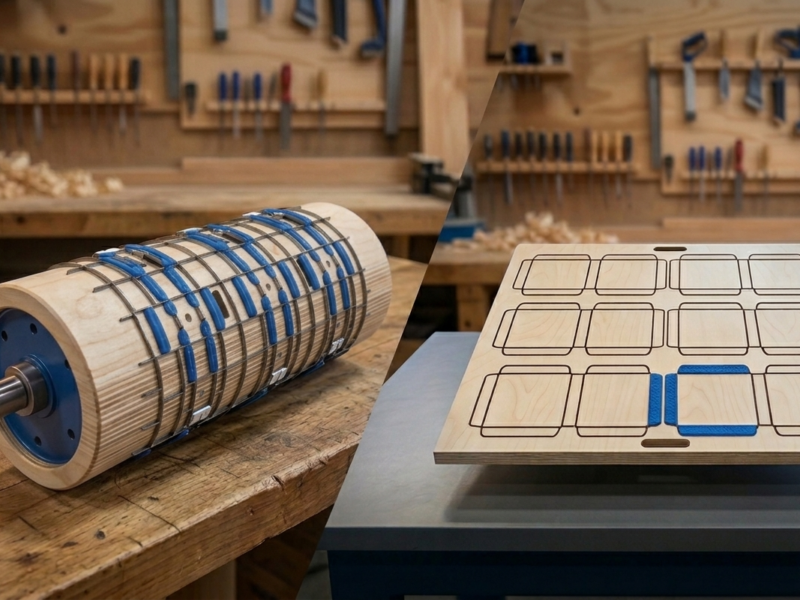
Rotary dies are cylindrical and operate in a continuous motion. The board feeds through the machine while the die rotates, cutting as it goes. This allows for extremely fast production speeds and is ideal for high-volume runs.
Flatbed dies, on the other hand, are stationary. The board is pressed against the die in a stamping motion, cutting one impression at a time. While slower, this method allows for greater control and precision—especially for more complex designs.
Neither method is inherently better. The right choice depends entirely on your application.
When Rotary Dies Make the Most Sense
Rotary die cutting is built for speed and efficiency. If your operation is focused on high-volume production with consistent designs, rotary is often the clear choice.
In many box plants across Western Canada and the Pacific Northwest, rotary dies are the backbone of production for standard corrugated packaging. Think regular slotted containers (RSCs), simple die-cut boxes, and repeat orders that run in large quantities.
Because the process is continuous, rotary die cutting allows for:
- Faster run speeds
- Lower cost per unit at scale
- Reduced labour per unit
- Seamless integration into high-speed production lines
For businesses producing thousands—or even millions—of the same box, these efficiencies add up quickly.
However, that speed comes with some trade-offs. Rotary dies are typically less suited for highly intricate designs or tight tolerances. Overly complex layouts can lead to compromises in cut quality or require additional adjustments.
That said, for the majority of standard corrugated applications, rotary dies deliver unmatched productivity.
Where Flatbed Dies Excel
Flatbed die cutting is all about control and versatility. Instead of prioritizing speed, it prioritizes precision and design capability.
Because the die presses directly into the board, flatbed cutting allows for:
- Cleaner, more accurate cuts
- Better handling of intricate shapes and tight radii
- Improved performance on thicker or multi-wall board
- Greater flexibility in design complexity
This makes flatbed dies ideal for:
- Retail-ready packaging
- Custom die-cut mailers
- Displays and specialty packaging
- Short-run or prototype jobs
- Heavy-duty applications like double wall and triple wall corrugated
If your packaging requires detailed cuts, complex folding structures, or premium presentation, flatbed is often the better option.
While it runs slower than rotary, the trade-off is higher quality and design precision, which can be critical depending on the end use.
Cost Considerations: Upfront vs. Long-Term Efficiency
Cost is often a deciding factor when choosing between rotary and flatbed dies, but it’s important to look beyond just the initial price.
Rotary dies tend to have a higher upfront cost due to their cylindrical construction and specialized manufacturing process. However, for long production runs, they typically offer a lower cost per unit because of their speed and efficiency.
Flatbed dies are generally more cost-effective upfront and are ideal for shorter runs or projects where frequent design changes are expected. You avoid over-investing in tooling for jobs that may not repeat at scale.
The key is aligning your die choice with your production volume. Investing in a rotary die for a short-run project can be unnecessary, while relying on flatbed for high-volume work can limit your efficiency.
Matching the Die to the Board
Another critical factor is the type of corrugated board you’re working with.
Heavier materials—such as double wall, triple wall, or specialty laminated board—often perform better with flatbed die cutting. The added pressure and control help ensure clean cuts and proper scoring without damaging the board.
Lighter materials and standard single-wall board are well-suited for rotary systems, especially when speed is a priority.
Choosing the wrong method for your board type can lead to issues like cracking, incomplete cuts, or excessive wear on your equipment.
Production Flow and Operational Efficiency
Beyond the die itself, your overall production setup plays a role in determining the best fit.
Rotary systems are typically integrated into inline production environments where speed and automation are key. If your plant is built around high-output workflows, rotary dies will align naturally with your operation.
Flatbed systems, meanwhile, are often used in more flexible production setups where customization and variation are common. They allow operators to handle a wider range of designs without sacrificing quality.
In many cases, manufacturers use both methods depending on the job—leveraging rotary for volume and flatbed for precision work.
Why the Right Die Partner Matters
Choosing between rotary and flatbed is only part of the equation. The quality of the die itself—and the expertise behind it—can make or break your results.
A well-built die ensures:
- Consistent cutting and creasing
- Reduced downtime on your machines
- Better performance across long runs
- Less material waste
At Fusion Die Lines, we work closely with customers to understand their application, production environment, and goals before recommending the best approach. Whether it’s rotary or flatbed, the focus is always on delivering a die that performs reliably on your floor.
Supporting Western Canada & the Pacific Northwest
For manufacturers across British Columbia, Alberta, Washington, and Oregon, having a die partner that understands your operational demands is critical.
Based in the suburbs of Vancouver, BC, Fusion Die Lines is positioned to support the entire region with fast turnaround times and dependable service. With strong shipping partnerships across Western Canada and the PNW, we ensure your dies arrive quickly—so your production stays on track.
Final Thoughts
There’s no one-size-fits-all answer when it comes to rotary vs. flatbed die cutting. The right choice depends on your volume, design complexity, material, and production goals.
Rotary dies deliver unmatched speed and efficiency for high-volume runs. Flatbed dies provide the precision and flexibility needed for more complex or specialized packaging.
Understanding the strengths of each allows you to make smarter decisions, reduce inefficiencies, and get the most out of your operation.
Get a Quote
If you’re unsure which die type is right for your next project—or you’re looking for a reliable partner who can deliver both quality and speed—Fusion Die Lines is here to help.
Get a quote today by reaching out to: Orders@Fusiondies.com
Recent Comments